Holding company
Connecting people
and technology.
MENSEN.WORK brings together publishing, advisory, investment and development activities at the intersection of people, technology and institutional responsibility. Its ventures help organisations understand and govern the impact of AI, digital dependency and information systems on decision-making, trust and human agency.

About
MENSEN.WORK is not a traditional advisory firm, but a combination of venture development, publishing, advisory and investment.
It develops and supports ventures, publications and advisory practices that help organisations make better decisions where people and technology meet.
The portfolio is intentionally diverse, but connected by one question: how can people and institutions retain judgment, agency and responsibility in increasingly complex digital environments?
Book
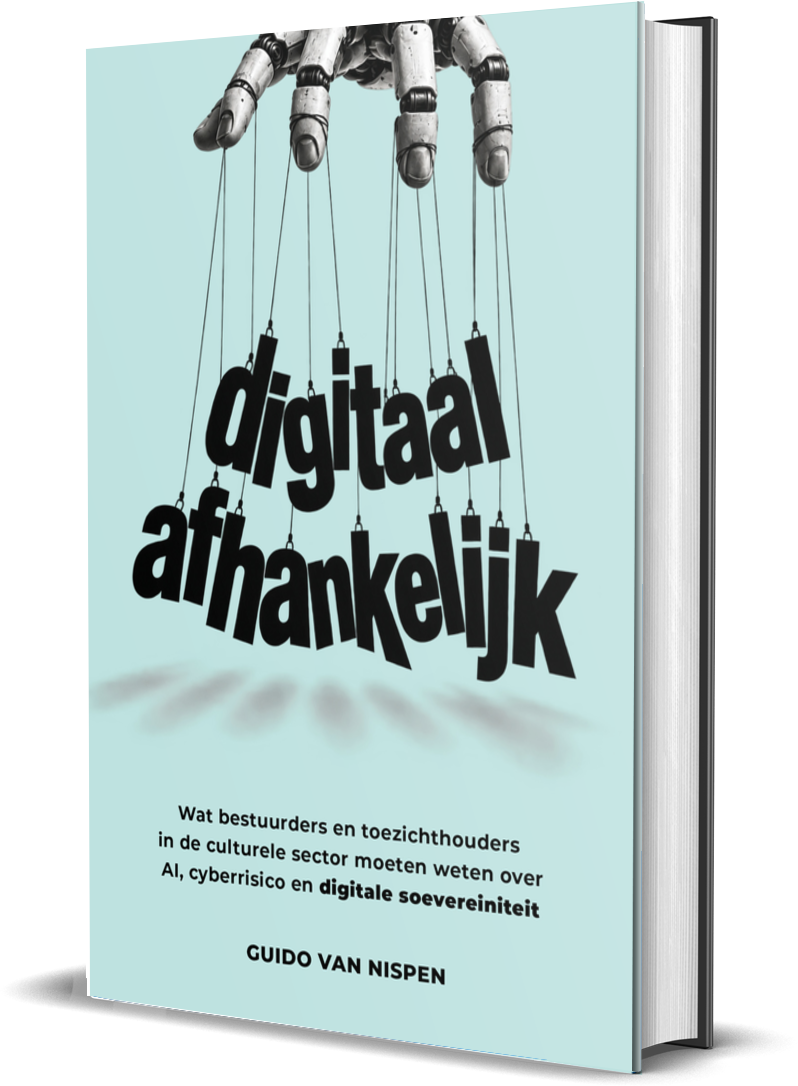
Forthcoming
Digitaal Afhankelijk
Digitale governance is voor culturele instellingen wat financiële governance twintig jaar geleden werd: een vast onderdeel van goed bestuur en goed toezicht.
Culturele instellingen worden bestuurd in een werkelijkheid die sneller verandert dan de bestuurstafel laat zien. Een AI-tool herschrijft een zaaltekst. Eén ticketleverancier legt tientallen musea tegelijk stil. Een oud account heeft toegang. Belangrijke data staan op Amerikaanse servers. Zulke situaties beginnen technisch, maar eindigen bestuurlijk.
Digitaal Afhankelijk laat zien dat AI, cyberrisico en digitale afhankelijkheid drie kanten zijn van één bestuurlijke opgave. Het is geschreven voor jou als je verantwoordelijkheid draagt voor cultuur en de taal van digitalisering niet vanzelfsprekend spreekt. Het biedt bestuurstaal en vragen om proportioneel en zonder schijnzekerheid met digitale vraagstukken om te gaan. Het boek komt met softwaretools die vanuit de governancepraktijk zijn gebouwd en direct in de bestuurskamer kunnen worden ingezet.
Het boek schrijft niet voor wat je moet vinden; het helpt je het gesprek te voeren dat in veel instellingen te lang is uitgesteld.
Read about the book in English
For cultural institutions, digital governance is becoming what financial governance became twenty years ago: an integral part of good management and oversight.
Cultural institutions operate in a world that changes faster than the boardroom reveals. An AI tool rewrites an exhibition text. A single ticketing provider brings dozens of museums to a standstill at once. An old account still has access. Important data are stored on American servers. Such situations start as technical issues, but end up as matters of governance.
Digitaal Afhankelijk shows that AI, cyber risk and digital dependence are three sides of a single governance challenge. It is written for you if you carry responsibility for culture and the language of digital technology does not come naturally to you. It offers the language of governance and questions to help you address digital issues proportionately and without false certainty. The book comes with software tools built from governance practice, ready for use in the boardroom.
The book does not prescribe what you should think; it helps you have the conversation that too many institutions have put off for too long.
Tools that come with the book
- With the book Board self-assessment
- For cultural institutions Cyber risk assessment
- Workbook Tools for boards and supervisors
Talks and board sessions based on the book are available on request.
Portfolio
Governance & Culture
For cultural institutions, executives, boards and supervisors — governance, AI, cyber risk, digital dependency and board-level responsibility.
-
 Visit Governance.Art
Governance.Art
Governance.Art helps boards, executives and cultural institutions govern digital dependency, AI and cyber risk. It translates complex technological developments into practical questions of responsibility, resilience and institutional judgment.
-
 Visit CodeCultuur
CodeCultuur
CodeCultuur is the Dutch knowledge and publication line within Governance.Art, focused on governance, accountability and digital resilience in the cultural sector. (In Dutch — Under Development)
-
 Visit Insiber
Insiber.com
Insiber is the cyber-resilience foundation of the practice — board-level tools to understand, control and insure cyber risk for commercial and not-for-profit organisations and insurers. Its insights now inform Governance.Art and the broader approach to digital dependency and institutional resilience.
Media & Information Intelligence
For media organisations, publishers, editorial teams and public information institutions. Information Governance sets out the conditions under which public knowledge holds; Polders / News Intelligence helps them understand how narratives align, diverge and reshape public meaning in an AI-driven information environment.
-
 Visit Information Governance
Information Governance
An open forum on the conditions under which public knowledge is produced, verified, preserved, made accessible, connected and corrected. It holds a citable, versioned framework of five functions that any institution can adopt, test or discard. (Open forum)
-
 Visit Polders.Media
Polders.Media
Holding of News Intelligence and Polders.News.
-
 Visit News Intelligence
News Intelligence
Makes visible where narratives align, where they diverge, and where perspectives may be absent altogether. Built for executives, policymakers and institutions navigating complex, multi-source realities.
-
 Visit Polders.News
Polders.News
Multi-narrative synthesis and creation.
Human Collaboration & Rights
For creators, professionals and organisations working with voice, rights, communication and human collaboration in the age of AI.
-
 Visit MyRights
MyRights
MyRights is a rights intelligence platform that helps creators, performers, producers and media organisations navigate the growing complexity of ownership, licensing and attribution in the age of AI. Rather than adding another layer of administration, it provides a structured way to understand, document and manage rights relationships as technology reshapes how creative work is created, distributed and reused. (Under Development)
-
 Visit Voicefilter
Voicefilter
Experimental AI agent that creates specific content for polemic columns. Dutch only at present.
-
 Visit Pattern Mirror
Pattern Mirror
A lightweight reflection tool. People answer a small set of questions about how they prefer to communicate, decide, give feedback and handle disagreement. Profiles can then be placed in the same frame and compared.
Working with us
For boards and cultural institutions
Digital governance assessments, board briefings and advisory work on AI, cyber risk and digital dependency.
For media organisations and information professionals
News intelligence, narrative divergence analysis and tools for understanding multi-source information environments.
For creators and organisations managing rights and collaboration
Tools and frameworks for rights intelligence, voice, communication and human collaboration in the age of AI.
Contact
For introductions, advisory enquiries, or to discuss a venture or investment, we welcome a direct conversation.